














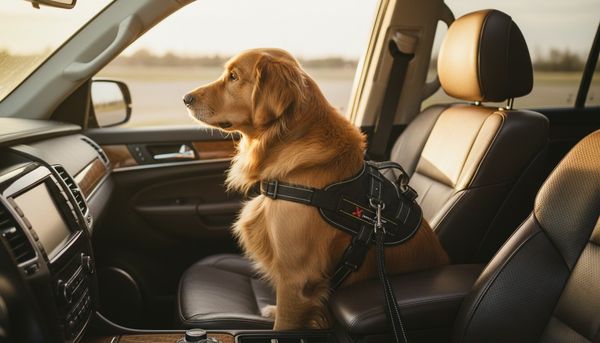
When choosing a travel solution for your pet, the term 'crash tested' appears on everything from £20 harnesses at Argos to £500 bespoke crates. However, without a universal UK standard for dog car restraint safety, these labels can be misleading. To truly protect your canine companion, you must look past the marketing and understand the fundamental physics of a collision. In a 30mph crash, an unrestrained 25kg Border Collie becomes a projectile with the force of nearly 1,000kg. This article explores the mechanics of crash dynamics—including rotational forces, material fatigue, and energy absorption—to empower you with the engineering knowledge required to evaluate any safety product on the market today, ensuring your dog remains safe on every journey across Britain's motorways.
The Lethal Math: Why Mass and Velocity Matter
To understand the necessity of a robust dog car restraint, we must first look at Newton’s Second Law of Motion: Force equals mass times acceleration (F=ma). In the context of a car accident, this is often expressed as 'impact force'. When a vehicle stops abruptly, any unrestrained object continues to move at the original speed until it hits something. In the UK, most urban speed limits are 30mph (48km/h). While this feels slow, the physics are unforgiving.
A dog weighing 30kg—roughly the size of a Golden Retriever—travelling at 30mph will exert roughly 900kg to 1,200kg of force upon impact. This is not just a danger to the dog; it is a lethal threat to human passengers. A restraint’s primary job is to manage this massive energy spike. When evaluating a harness or crate, you are looking for its 'dynamic load' rating. High-quality engineering ensures that the restraint can withstand multiple times the dog's weight to account for the 'g-force' experienced during the milliseconds of a collision. If a product doesn't specify the weight limit it was tested for, it is effectively an unknown variable in your safety equation.
Tensile Strength and Material Integrity
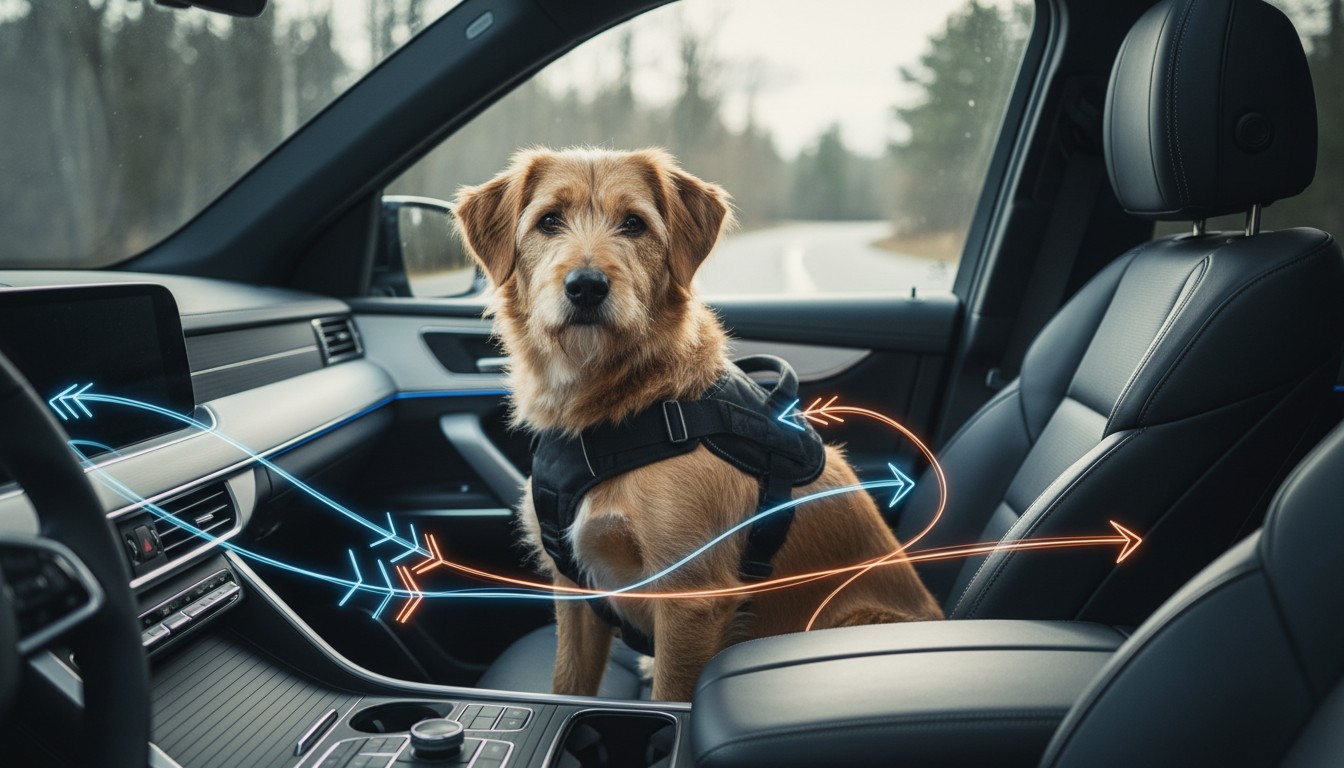
The 'weakest link' principle is never more relevant than in dog car restraint safety. Most budget harnesses found in local pet shops are made of standard nylon webbing and plastic buckles. While these are fine for a walk in the Lake District, they are physically incapable of surviving a high-velocity impact. Professional-grade restraints utilise automotive-grade polyester webbing, which has a much higher tensile strength and lower 'creep' (permanent stretching) than standard nylon.
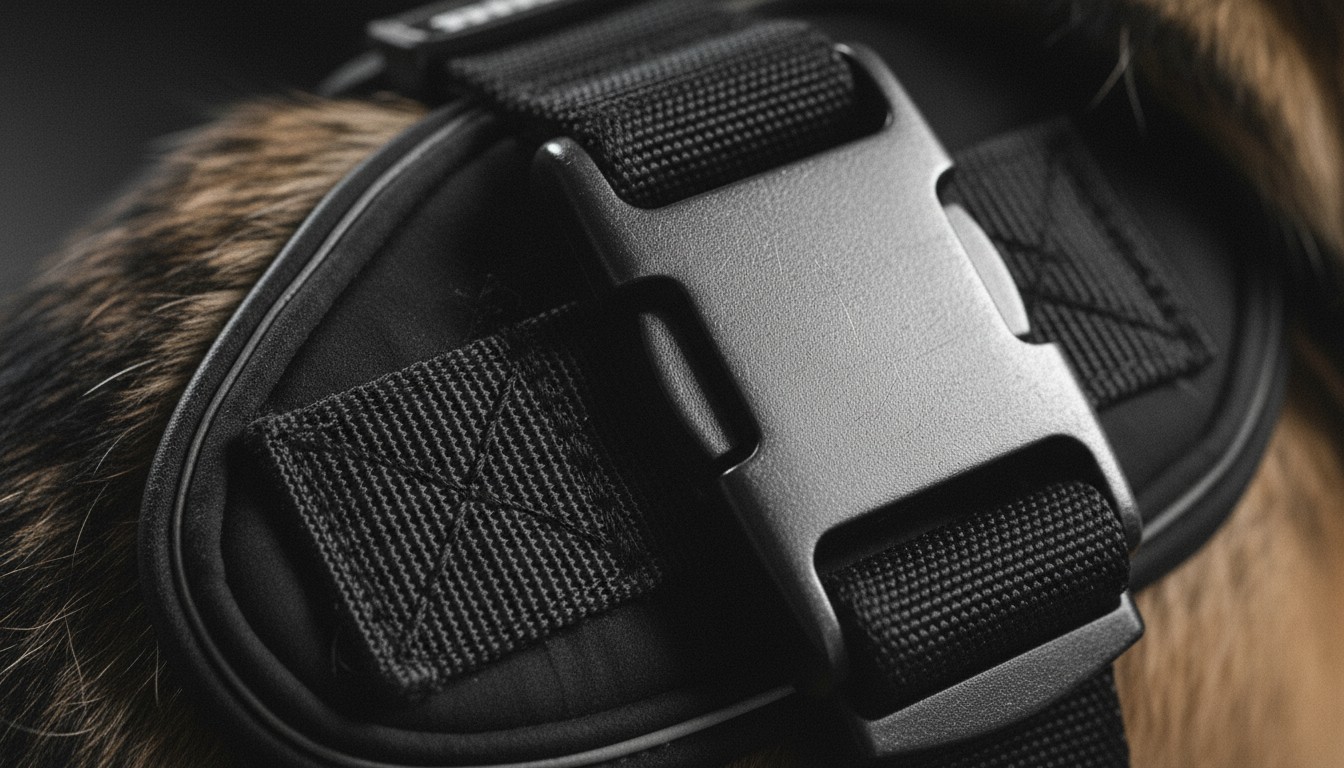
Look closely at the stitching patterns. Safety-critical stitching usually follows a 'Box-X' or 'W' pattern, designed to distribute force across a larger surface area of the fabric. Metal hardware is equally vital. Plastic side-release buckles often shatter under loads exceeding 150kg. For genuine safety, seek out hardware made from drop-forged steel or aircraft-grade aluminium. These materials are designed to deform slightly under extreme stress—absorbing some of the energy—rather than snapping instantly. When browsing stores like John Lewis or Halfords, check if the hardware is 'load-rated' and if the webbing feels comparable to the seatbelts used by human passengers.
Rotational Mechanics and the 'Second Collision'
A common mistake in evaluating dog car restraint safety is only considering the forward motion. Physics, however, involves three-dimensional movement. When a car is hit at an angle, or spins after an impact, rotational forces (torque) come into play. A long tether or a loose harness can allow the dog to 'launch' and then be snapped back violently, or to rotate mid-air and strike the car's interior pillars or windows.
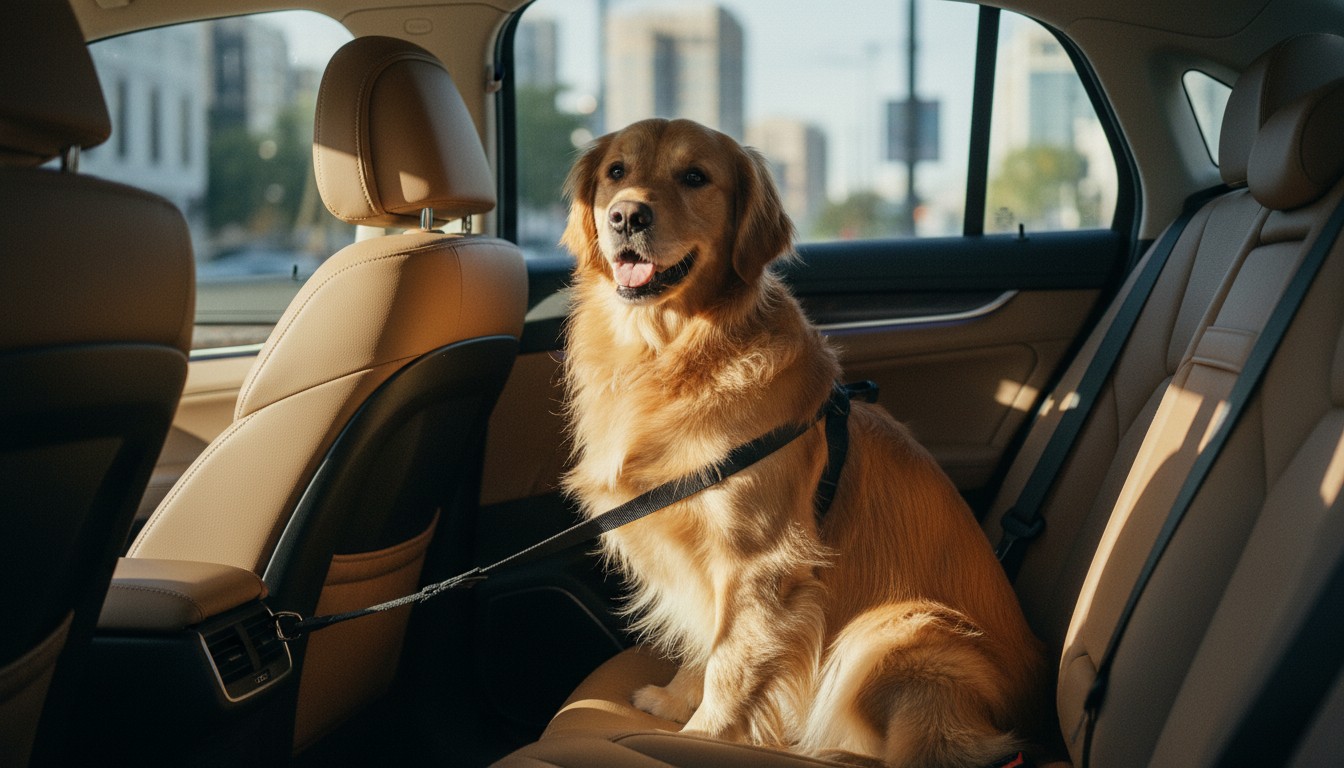
This is known as the 'second collision'—where the dog hits the restraint or the car's interior. A short, static attachment point to the vehicle's seatbelt system is superior to a long, elasticated lead. The goal is to limit the 'excursion distance' (how far the dog moves from the seat). In a crate, this is managed by the interior dimensions. A crate that is too large allows the dog to gain momentum before hitting the crate wall. Engineering-wise, the safest restraint is one that keeps the dog’s centre of gravity as close to the seat or floor as possible, minimising the arc of rotation during a side-impact or roll-over event.
Crumple Zones: Energy Absorption in Crates
For those who prefer crates over harnesses, the material choice is a matter of life and death. Many owners believe a heavy, rigid steel cage is the safest option. However, physics suggests otherwise. In modern car design, 'crumple zones' are engineered to collapse, absorbing the kinetic energy of the crash so it isn't transferred to the passengers. A perfectly rigid steel crate can act as a 'battering ram' against the back of the passenger seats or, worse, transmit 100% of the impact energy directly to the dog's skeleton.
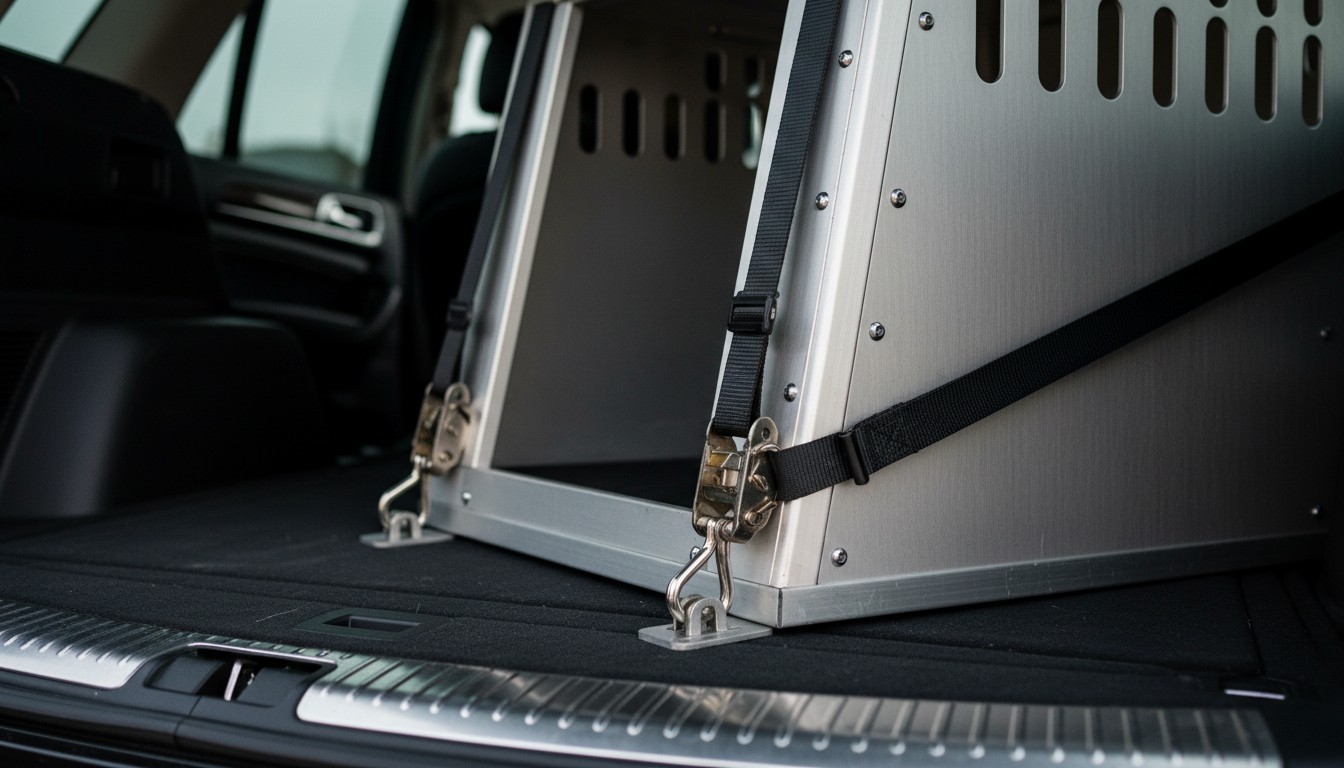
The safest crates, such as those designed for the 'boot' of an estate car or SUV, incorporate energy-absorbing frames or deformation zones. Aluminium is often preferred because it offers a high strength-to-weight ratio and can bend predictably. Furthermore, the crate must be secured to the vehicle’s ISOFIX points or heavy-duty lashing eyes. If the crate is simply resting in the boot, it becomes a multi-kilogram projectile itself. When evaluating crates at retailers like Pets at Home, check the base and frame for 'crush-proof' or 'energy-dissipating' features rather than just looking at the thickness of the bars.
The ISOFIX Connection: The Chain of Survival
A restraint is only as strong as its anchor point. In the UK, cars manufactured after 2006 are required to have ISOFIX points. These are metal loops welded directly to the vehicle's chassis. Using these points for dog car restraint safety is significantly more secure than using the standard seatbelt buckle, which is designed for the specific geometry of a human torso. Some high-end dog travel systems now offer ISOFIX connectors, providing a direct, rigid link to the car's frame.
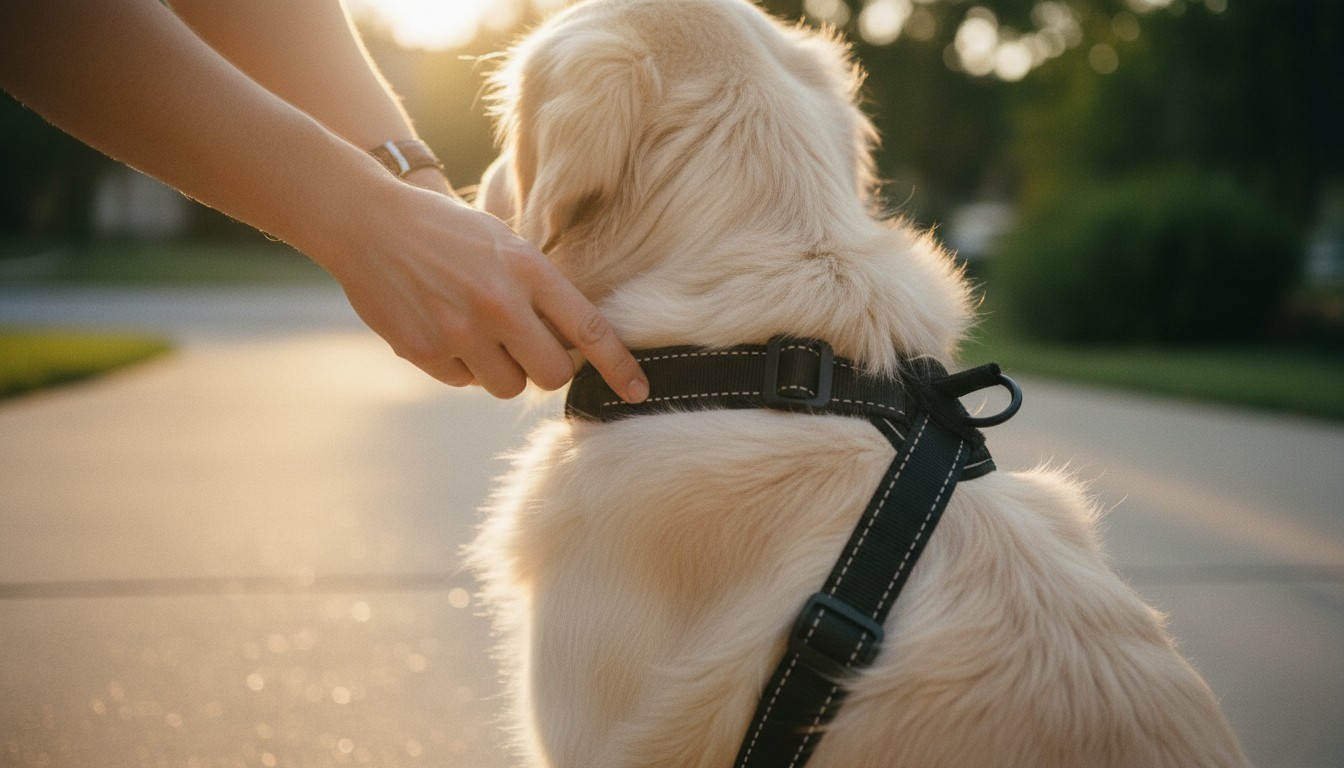
If you are using the seatbelt as an anchor, ensure the belt is 'locked' into its emergency retraction mode. For harnesses, the connection point should ideally be at the dog’s back, between the shoulder blades. This aligns with the dog’s spine and ribcage—the strongest parts of their anatomy—to distribute the force. Avoid any restraint that attaches to a collar; even a minor 'shunt' at 10mph can cause permanent tracheal damage or cervical spine fractures. Always inspect your car's anchor points for rust or wear, especially in older vehicles, as the 'chain of survival' is only as strong as its weakest link.
Troubleshooting: Identifying Weak Links
Even the best engineering fails if the fit is incorrect. A common issue is 'webbing slack'. If you can fit more than two fingers between the harness and your dog's chest, the 'jerk' during an impact will be significantly more damaging. Another sign to adjust your approach is 'panting or distress' during travel; often, a harness that is too tight or restricts natural movement can cause overheating or anxiety, leading to a distracted driver.
Signs you should seek professional advice or upgrade your gear include visible fraying of the straps, salt-corrosion on metal buckles (common if you live near the British coast), or if your dog has outgrown their weight category. If your dog is particularly small (under 5kg) or large (over 40kg), standard 'one-size-fits-all' solutions rarely work. In these cases, consult a specialist in canine car ergonomics or look for brands that provide specific technical data sheets rather than generic marketing brochures. Remember, a safety system that worked for a puppy will likely fail the physics test once that puppy becomes a fully grown adult.
FAQ
Does the UK law require dogs to be restrained in cars?
Yes, Rule 57 of the Highway Code states that dogs must be suitably restrained so they cannot distract the driver or cause injury to themselves or others in the event of a stop. Failure to do so can lead to a fine of up to £5,000 and points on your licence under 'driving without due care and attention'.
Can I use a standard walking harness for car travel?
Generally, no. Standard walking harnesses are designed for low-tension pulling and usually feature plastic buckles that will shatter under crash forces. A safety-rated car harness is engineered with higher tensile strength webbing and metal hardware specifically to survive high-velocity impacts.
Is the front seat safe for a dog if they are restrained?
The back seat is significantly safer. Front-seat airbags deploy with enough force to seriously injure or kill a dog, even if they are in a harness. If you must use the front seat, you must ensure the passenger airbag is deactivated and the seat is pushed as far back as possible.
What does 'crash-tested' actually mean in the UK?
In the UK, there is no specific 'dog car seat' regulation like the ECE R44 for children. When a brand says 'crash-tested', it usually means they have voluntarily used a facility to test against certain speeds. Always ask for the 'test report' to see what weight and speed were actually used.
Conclusion
Evaluating dog car restraint safety requires a shift from viewing gear as a 'pet accessory' to viewing it as 'safety equipment'. By understanding that impact force is a product of mass and acceleration, and that rotational forces and material fatigue play critical roles, you can make an informed choice that actually protects your pet. Don't rely on ambiguous marketing terms; look for load-rated hardware, automotive-grade materials, and secure ISOFIX connections. Regularly inspect your equipment for wear and tear, and ensure the fit is precise. While no restraint can guarantee safety in every scenario, applying these engineering principles significantly tilts the odds in your favour. For bespoke advice, especially for dogs with physical disabilities or unique sizes, consult a canine biomechanics expert to ensure your travel setup is as robust as possible.
References & Sources
This article was researched using the following sources:


