















Every pet owner has experienced the 'head tilt'—that moment of visible confusion when a dog isn't sure if you said 'Sit' or 'Stay.' To us, these words are distinct, but to an animal, they are simply auditory frequencies. Improving your cue selection and discrimination is the foundation of clear communication. Discrimination is the process by which a pet learns to perform a specific behavior in response to one signal but not another. By understanding the linguistic architecture of training, you can move away from guesswork and build a reliable vocabulary that your pet understands even in high-distraction environments.
The Hierarchy of Perception: Why Visuals Win
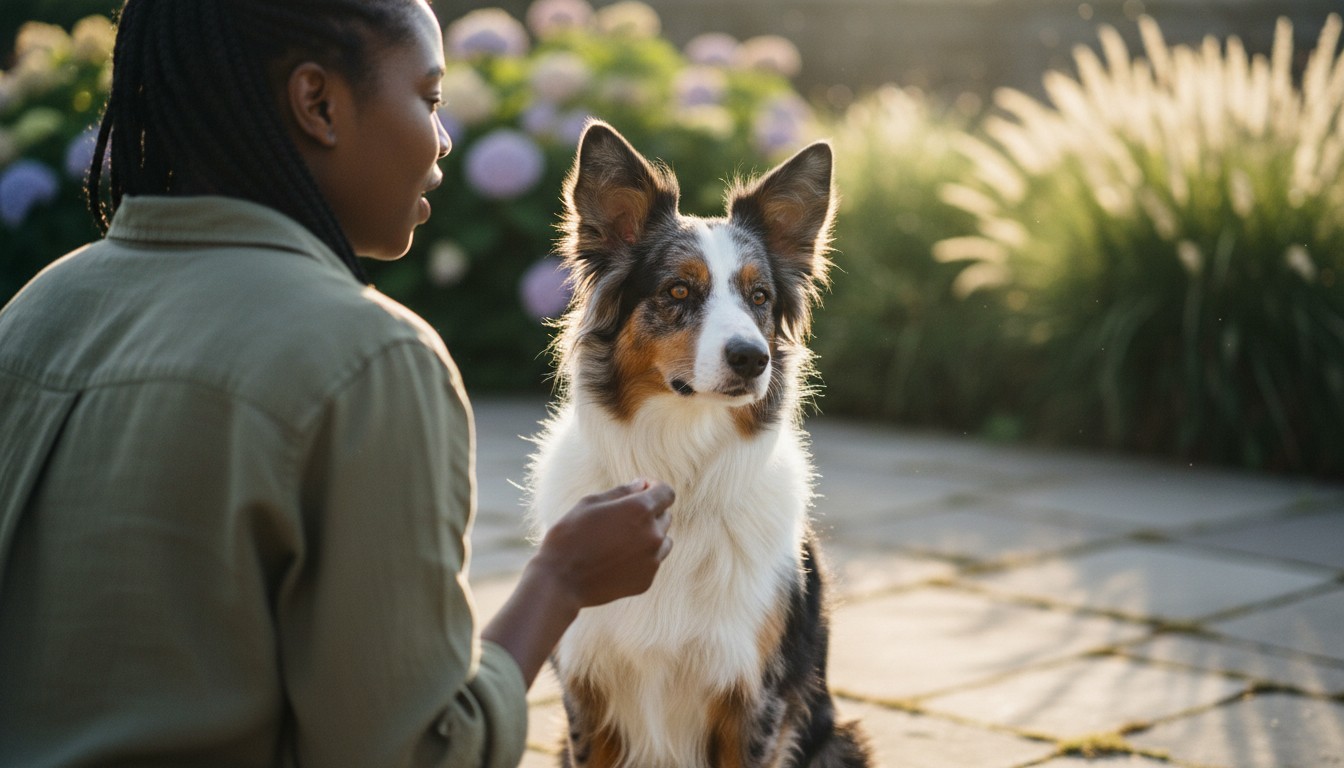
To build a robust training system, we must first acknowledge that dogs and humans process information differently. While humans are a primarily verbal species, research from Emory University using fMRI scans has shown that the canine brain processes visual signals and scents much faster than auditory ones. This biological reality means that if you give a hand signal and a verbal command simultaneously, your dog will almost always focus on your hand. This is known as 'overshadowing.'
Dogs also possess a higher Critical Flicker Fusion (CFF) rate than humans, which essentially means they perceive motion in higher resolution. A slight twitch of your shoulder or a hand moving toward a treat pouch is often processed by the dog before you even finish speaking. To ensure your pet is actually listening to your words rather than reading your body language, you must consciously separate the two. Professional trainers recommend a 'New Cue, Old Cue' sequence: say the new verbal word, wait a fraction of a second, then provide the visual signal they already know. This brief pause forces the brain to anticipate the known signal based on the new auditory input.

Designing Your Lexicon: The Phonetics of Training
When selecting verbal cues, think like a linguist rather than a storyteller. Most owners make the mistake of choosing words that sound too similar. For example, 'Sit' and 'Stay' both begin with a sharp 'S' sound followed by a hard consonant or vowel. In a noisy environment (above 60-70 decibels), these can easily be confused. To improve cue selection and discrimination, choose words with distinct vowel shapes and syllable counts.
Consider using 'Down' (a long 'ow' sound) versus 'Sit' (a short 'i' sound). If you have multiple dogs, the confusion is compounded. Experts suggest using two-syllable words for some actions and one-syllable for others. For instance, 'Stand' (one syllable) is easily distinguished from 'Belly' (two syllables). Additionally, avoid 'poisoning' your lexicon by using words common in everyday conversation. If you say 'Okay' to your friends frequently, don't use it as a release word for your pet. Instead, opt for something unique like 'Break' or 'Free' to maintain the signal's value.

Discrimination Protocols: Stopping the Guessing Game
If your pet offers a 'Sit' when you asked for a 'Down,' they aren't being stubborn; they are guessing based on the context. Discrimination training is the formal procedure used to teach a pet that only a specific stimulus (the cue) leads to a reward. To practice this, trainers use a 'discrimination trial.' Place two objects—like a target stick and a mat—about 1 meter (3.3 feet) apart. Ask for the 'Target' and reward only if the pet touches the stick. If they go to the mat instead, calmly wait and reset.
This process builds 'stimulus control.' A behavior is under stimulus control when it occurs immediately when the cue is given, does not occur in the absence of the cue, and does not occur in response to a different cue. To achieve this, you must stop rewarding 'offered' behaviors during discrimination sessions. If your dog sits without being asked, acknowledge it but don't treat it. You are teaching them that the most profitable path is to wait for your specific linguistic input. This reduces frustration for both the handler and the animal.

Cleaning Up 'Poisoned' Cues and Fuzzy Signals
A 'poisoned cue' is a command that has either lost its meaning through over-repetition or has acquired a negative association. A classic example is the 'Come' command. If you only call your dog to end their fun at the park or to give them a bath they dislike, 'Come' becomes a predictor of something unpleasant. In behavioral terms, the cue has been associated with an aversive consequence, leading to a sluggish or non-existent response.
Fixing a poisoned cue is often harder than starting from scratch. If your 'Come' command is broken, stop using the word entirely for 2-4 weeks. During this time, select a new cue like 'Here' or 'Pronto.' Rebuild the association by pairing the new word with high-value rewards like fresh chicken or a favorite toy. Ensure the new cue is never followed by something the pet finds punishing. By changing the linguistic label, you bypass the old negative neural pathways and build a fresh, enthusiastic response. This is the 'linguistic architecture' of a successful training reset.

Troubleshooting: When the Signal Gets 'Muddy'
One of the most common issues in cue selection and discrimination is 'nagging'—the habit of repeating a command when the pet doesn't respond immediately. Saying 'Sit, sit, sit...' teaches your pet that the first three words are just background noise and only the fourth one matters. This creates 'latency,' where the pet waits for you to become more insistent before acting. To fix this, give the cue once. If the pet doesn't respond within 3 seconds, they have missed the opportunity for a reward. Walk away, wait 10 seconds, and try again with a simpler version of the task.
Another frequent problem is environmental 'leakage.' Your pet may only understand 'Sit' when you are standing in your kitchen holding a treat pouch at waist height. This is called 'contextual binding.' To generalize the cue, you must practice in different rooms, while sitting on the floor, or even with your back turned. If the behavior falls apart when you change your posture, it proves the dog was discriminating based on your body position rather than your verbal word. Reset your criteria and slowly add these variations to ensure the cue is truly independent of the environment.
FAQ
Can I use words from a different language for training?
Yes, using a different language like German or French is a popular strategy to avoid 'poisoning' cues. Since you are unlikely to use these words in casual conversation, the signals remain distinct and high-value for your pet.
Why does my dog listen to my hand signals but not my voice?
Dogs are biologically wired to prioritize motion and body language. If you always use them together, your dog may never have learned the actual meaning of the word. Practice using the verbal cue first, followed by a pause, to encourage them to listen.
What is the best way to choose a release word?
Pick a short, punchy word that you don't use often in daily speech. 'Break' or 'Free' are excellent choices. Avoid 'Okay' because it is used too frequently in general conversation, which can lead to your dog accidentally breaking their stay.
Conclusion
Mastering cue selection and discrimination is not just about teaching tricks; it is about building a precise language that respects how your pet's brain works. By choosing phonetically distinct words, prioritizing the separation of visual and verbal signals, and guarding against 'poisoned' cues, you create a stress-free learning environment. Remember that training is a dialogue. If your pet is struggling to discriminate between two signals, the architecture of the communication likely needs an adjustment. Always consult a certified professional trainer if you encounter behaviors rooted in fear or aggression, as these require specialized behavioral modification beyond basic cue work. Start refining your vocabulary today, and watch your pet's confidence grow as the 'guessing' disappears.
References & Sources
This article was researched using the following sources:


